Posts Tagged ‘Fly Fishing’

Practice makes perfect

Wednesday, January 6th, 2010

Well, fishing has had to take a back seat again after all the snow. I was due to go Tuesday and glad I didn’t as getting home would have been a bit hairy.

As a result I have been casting and playing with a few things. It is great to go out and throw a few loops and can be good fun to do so with a buddy too. The only downside of this is that all the good intentions tend to go out of the window and the tape measure comes out and and bit of good banter as you take it in turns to see what you are made of!

The tape measure can be sobering for the first-time distance caster as throwing a full line and a 10ft leader doesn’t actually equate to 100ft. It is quite a long way from it. I don’t tend to do this much of late as I find the body doesn’t enjoy it as much as it used to and lets face it there are few, if any, situations you are going to want to see the backing flying out of the tip ring.

I always thought this would be the case when it came to bonefishing but I have been amazed over the last few years how short a distance a bone can be caught. If anything I’d say a well presented 40 to 50ft cast will always put you in with a shout.

Up against the tape- photo by Lee Cummings

Up against the tape- photo by Lee Cummings

This is where the practice comes in, not just for winter trips somewhere exotic but getting you ready for the new season whatever you like chasing with a fly rod.

For me 15 to 20 minutes of good casts pays better dividends than going out for 2 hours and trying too hard to get it right. When I practice I’ll tilt my casting plane over to the side and have a look at my timing and loop control both hauled and unhauled. By throwing everything over to the side it becomes much more visual and allows you to see everything that is going on. I’ll then make a basic overhead cast in the normal casting plane. It is the foundations of all overhead casts and is easily overlooked. It is then I’ll play with a few Roll Casts and Speys. There are now loads of Spey Casts to play with but I’ll work on the ones that are most practical for fishing situations we encounter on the streams in Devon and the ones I teach most. I’ll then add a few mends, hooks and curves and see how it looks and see how it feels from there. If there has been something that has niggled then I’ll go back and give it a bit of work.

At our fly fishing school I’ll teach repetition (with plenty of breaks) as this helps to encourage muscle memory and when my student tries it out for the first time alone their body says “Hey, I remember this”

At the end of the day though the fish decide whether it was a good cast or not and this is what it is all about. It is nice to throw a nice loop in the field but throw in a rising fish in a tricky spot and try telling me that isn’t more exciting.

I’m not advocating to go out for everyday in the months before the seasons start. Life is just too short, but try it now again and you might be surprised the difference it makes and it is really, really good fun!

www.devonschoolofflyfishing.com Fly Fishing tuition,lessons and guide in Devon

Report from the Dude

Thursday, February 12th, 2009

Ray is my fishing buddy and is so relaxed I call him the “Dude” after the character of the same name in the Cohen Brothers film The Big Lebowski. He has written a few words about a day we had on a salmon river  in NZ.  It was one of those things where you read about a river and it says no one really fishes it for trout as it is known for salmon.  But it sort of gets you thinking that firstly is that because no one actually does bother fishing it for trout or is it the details you have in front of you like this to keep you for fishing for trout? We probably looked into this too deeply but when it comes to fishing I think you have to…anyway, over to you Dude…

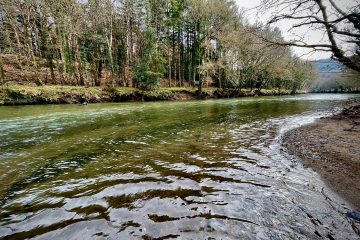
 Pete and I were told by locals that the Rangitata “was more of a salmon river”.  When we arrived at the upper gorge section upriver of Peel Forest, it was easy to understand why:  it was a big, fast water interrupted by long, deep pools.  the water was brilliant torquoise, almost artificial in colour, because of the light reflecting off the volcanic silt collected from its headwaters.

The Dude

The Dude

 Unfortunately, the strong Northwesterly wind was blowing whitecaps in the pools and we quickly decided that we wouldn’t be able to turn over even our seven weight lines.  disappointed, we got back in the car and drove back downriver hoping to find more trout friendly water and shelter from the wind.

 We found what we were looking for, but unfortunately the section ran next to a campground that was fully booked with locals enjoying a long weekend.  We figured that the water got a good pounding but it was getting close to lunchtime and we hadn’t fished so we decided to put in.
Pete took the first pool and I took the second.  Three campers arrived shortly after us in their swim gear and positioned themselves between us.  I immediately became annoyed, but Pete later told me that the two women and one man nuded up and went swimming, so I forgave them and thought what a pleasant addition to any fishing day that would be (seeing the women, that is) provided it didn’t adversely affect the fishing.
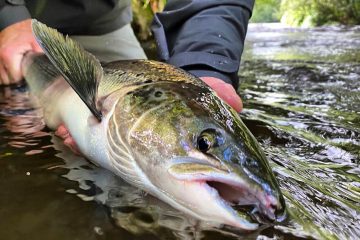
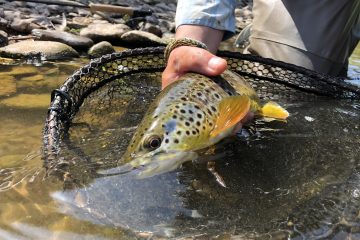
We ended the day with two fish each, the largest around 5lbs.  Every day we fished the South Island I learned a thing or two, and here’s what I took away from our day on the Rangitata:      
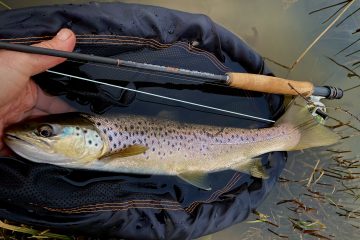
    1)  Don’t dismiss a river that “was more of a salmon river” as not holding trout.  Pete and I chose the Rangitata deliberately to avoid other trout fishermen.  If you can fish the sections that the salmon fishermen avoid, you may find some trout that haven’t been fished to, even if they are next to a campground.
    2)  Fish lighter tippet than you think would be appropriate.  Although 5lb. tippet is standard for the size of fish we were catching, I fished 3lb. test for most of our trip.  The lighter tippet seemed to help with wary fish.  On big, open rivers like the Rangitata or the nearby Rakaia there aren’t many snags or other places for fish to pop you off.  My normal bias is to fish heavier than appropriate tippet to hasten the fight, but I found that quickly making my way to calm water as the fish tired was the best way to achieve a quick release. 
    3)  Always choose the first pool downriver of nude lady swimmers.